Even when we work with individuals, couples’ issues come up all the time and are often of the greatest importance in psychotherapy. The person’s relationship with the spouse or partner has a HUGE effect on his or her happiness. Here I am sharing some brief, general tips that I have learned for working with couples’ issues. Tips for how to communicate better, working with issues of sexuality, etc will be discussed in separate articles.
On this page, we want to share some general tips for working with couples’ issues, and our recommendations for a highly selected—and deliberately limited—shortlist of the BEST books for couples to improve their relationship.

“Fix him!” or “Fix her!”
The biggest problem in working with couples’ issues and one that must be tackled first and foremost is that every person I have ever spoken to says that it the partner who needs to be fixed! As therapists, we must notice this early on and deal with it. For any change to happen, the person has to realize that we can only work on ourselves. The only person we can directly change is ourselves.
We shouldn’t say to our clients that there is no problem with the partner because that is obviously not true. Rather, we should say to the person that, of course, we have no ability to change the partner, so let’s talk about what you should do differently. Whether your partner changes or not, is not in our control. That’s it. I have been surprised how effective it is to simply note this fact and to avoid getting into discussions with the person about how it is the partner who needs to change. It almost seems to come as a surprise to the person that we can only change ourselves. 🙂 This needs to be done repeatedly though, every time the person starts blaming the partner. After letting the person ventilate for a bit, we should gently remind them about what our therapy is going to focus on.
If we don’t follow this advice, the therapy sessions can easily become a place where the person comes to complain about the partner.
“Why can’t you be more like me?”
From the book The Art of Marriage Maintenance (see below)
Learning to know and accept how their partner is different from them is very important for any person’s relationship to improve.
People can feel cheated on finding out how different the spouse is from them. Most people seem to have a strong need to change their partner. Why can’t you be like me? They rarely want to change themselves; they want their partner to be like them. A common mistake that is poisonous to the relationship is that my way is the only way. But, can people really change in a fundamental way? Even if the partner makes some constructive changes, will this satisfy the person?
Since there are natural differences between men and women, the problem is even more prominent in heterosexual relationships.
The authors note that not fully understanding how the partner is different from them, people reach wrong conclusions about their partner–that he/she is illogical, self-centered, uninterested, etc. It may be that he or she is simply different!
Helping our patients to understand this and to become explicitly aware and accepting of the differences is one of the most important ingredients for successful therapy about relationship issues.
How can we find some positivity where there seems to be none?
From the book The Seven Principles for Making Marriage Work (see below)
Often, when we are talking to a person about severe relationship problems, there is a great amount of hurt, anger, and disappointment. The person may have nothing positive to say about the partner. In such situations, first ask the person questions about how the couple met, what attracted the person to the partner, what did he/she like in the partner, etc. This often helps remind the person about some of the positive qualities of the partner. If there is no positivity in the present, you can find some positivity in the past.
I have also found it helpful to gently draw the person’s attention to the huge discrepancy between how the person remembers the partner early in the relationship and now.
Do you have questions, comments, or tips about couples’ issues? We would love to hear from you! Please post them at the bottom of this page under “Leave a reply”

By Sylvia R. Karasu MD and T. Byram Karasu MD
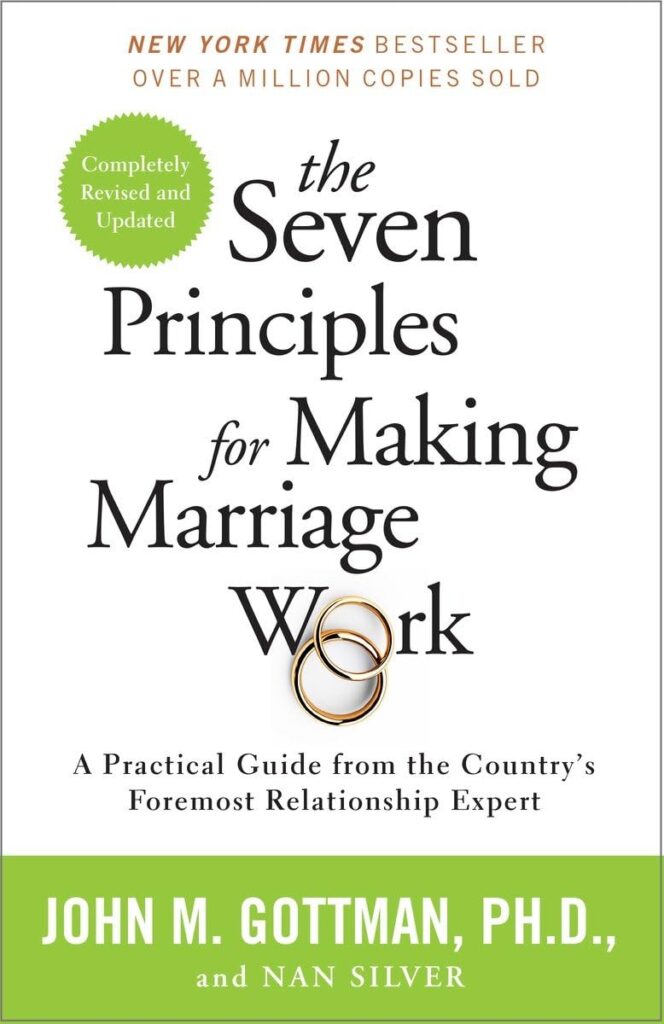
By John M. Gottman PhD and Nan Silver

By John Gray PhD
Disclosure: The links above are Amazon affiliate links. Buying products from Amazon.com using links on this website helps to support this website at no additional cost to the purchaser. But, we still want to be fully transparent about this.
Related Pages
What are the BEST books on each topic related to psychiatry/ mental health?
Copyright © 2016 to 2025, Simple and Practical Medical Education, LLC. All rights reserved. The content on this website may not be reproduced in any form without express written permission.
Disclaimer: The material on this website is provided as general education for medical professionals. It is not intended for patients or other laypersons, nor is it a substitute for medical advice, diagnosis, or treatment. Patients must always consult a qualified healthcare professional regarding their diagnosis and treatment. Healthcare professionals should always check this website for the most up-to-date information.
Leave a Reply