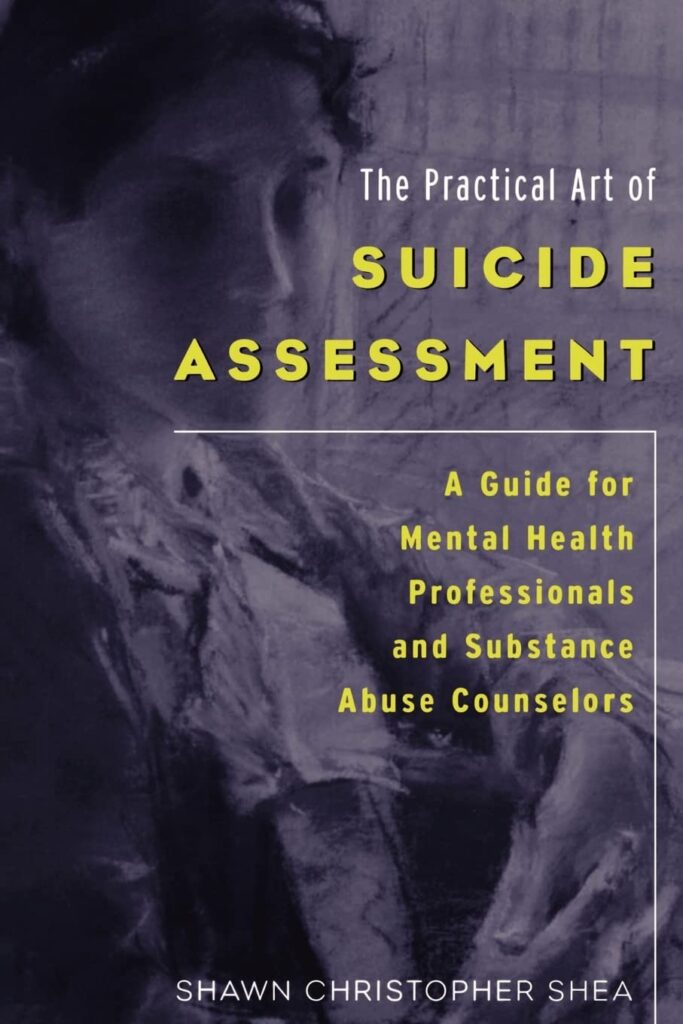
by Shawn Christopher Shea
Reviewed by Rajnish (“Raj”) Mago, MD
Clinical assessment of the risk of suicide is definitely, as the title of this book states, a “practical art.” And this book truly lives up to its title. It is not a review of the published research on suicide, its epidemiology, neurobiology, and so on. It is a practical guide to this art, crucially important but challenging, in which we must continually strive to improve our skills. That is why this book will be helpful to all clinicians who need to assess suicide risk, regardless of their level of experience.
For our interview with Dr. Shea, in which he shares so many practical tips about skillfully interviewing patients, including for assessing the risk of suicide, please see the following article on this website:
Psychiatric Interviewing: Interview with Shawn Christopher Shea, MD
Just to give you an idea of the content of this book, here are only a few of the many topics on which Dr. Shea provides practical tips:
– How to become aware of and be mindful of our own conscious or subconscious beliefs about suicide, so that they don’t seriously interfere with our assessment of suicide risk in persons we evaluate (Chapter 4).
– Several interviewing techniques that should also be applied to suicide risk assessment, for “enhancing engagement while peeling away distortions.” These include Behavioral Incident, Shame Attenuation, Gentle Assumption, Symptom Amplification, Denial of the Specific, and Normalization (Chapter 5).
– Effectively eliciting suicidal ideation by first setting the stage for the inquiry and then using the CASE approach developed by the author (Chapter 6)
– Tips on safe and effective decision-making, including in specific clinical scenarios, for example, persons unknown to the interviewer and those in ongoing treatment with the interviewer; persons exhibiting mature defenses or those with severe personality disorder; and so on (Chapter 7).
– Several clinical vignettes, each followed by a detailed discussion of how to formulate the case and what to do (Chapter 7).
– How to document a suicide assessment (Appendix A).
Have you read this book? If so, please share your thoughts about it by posting a comment below (under “Leave a Reply”). Please also share which clinical tips in the book you have found particularly helpful.
Disclosure: Buying products from Amazon.com using the affiliate links on this page helps to support this website at no additional cost to the purchaser.
Related Pages
Suicidality: General articles
Five horrifying statistics about suicide we should all know
Suicide trends
How NOT to talk about suicide
Suicidality: Evaluation
The Three-Step Ladder: A better, easier way to start to ask about suicidal ideation
How to evaluate and categorize the type of suicidal ideation
Types of suicidal behaviors
Why and how to monitor and evaluate for suicide risk after bariatric surgery
Quick tips in suicide assessment: Interview with Jack Krasuski, MD
Suicidality: Resources
Practice guidelines for suicidality and self-harm
BEST books on suicide risk assessment and management
Suicidality: Medications that may increase the risk
In whom can antidepressants increase the risk of suicidality?
What can we do about suicidality associated with antidepressants?
Can isotretinoin (Accutane®, Roaccutane®) cause depression or suicidality?
What do published studies on isotretinoin and depression/ suicidality show?
Suicidality: Management
Tips on reducing the risk of death by suicide
Call 988, the “Suicide & Crisis Lifeline”
In suicidal patients, avoid 90-day prescriptions of these medications
Which psychiatric medications are particularly lethal in overdose?
Is ADHD associated with increased suicidality and does treatment reduce that risk?
Suicide: A New Conceptualization, A Neglected Question, and Specific Medications (Interview with David Sheehan, MD)
TED talk: The bridge between suicide and life
Miscellaneous
BEST books on Psychiatric Interviewing and Evaluation
What are the BEST books on each topic related to psychiatry/ mental health?
Copyright © 2018 to 2025, Simple and Practical Medical Education, LLC. All rights reserved. The content on this website may not be reproduced in any form without express written permission.
Disclaimer: The material on this website is provided as general education for medical professionals. It is not intended for patients or other laypersons, nor is it a substitute for medical advice, diagnosis, or treatment. Patients must always consult a qualified healthcare professional regarding their diagnosis and treatment. Healthcare professionals should always check this website for the most up-to-date information.
Leave a Reply